
**Quick Summary:** The Reserve Bank of India’s (RBI) Account Aggregator (AA) framework is a digital public infrastructure rail enabling individuals to securely share financial data between institutions through granular, revocable consent. Operating under RBI licenses as NBFC-AAs, aggregators function as data-blind pipes: they cannot see, read, store, or sell personal financial data. With over 350 million linked accounts and the RBI’s October 2026 interoperability directive, the AA ecosystem replaces insecure practices like screen scraping with bank-grade digital consent.
What Is an Account Aggregator and Why Did India Need It?
An Account Aggregator (AA) is an RBI-regulated Non-Banking Financial Company (NBFC-AA) licensed to retrieve and share financial records between institutions on behalf of a customer. Unlike traditional financial intermediaries, an Account Aggregator does not lend capital, underwrite loans, manage investments, or sell financial products. Its sole function is to act as an electronic consent broker.
To understand why the Reserve Bank of India established this framework, consider how financial data was shared prior to its rollout. For over a decade, Indian consumers applying for loans or wealth services faced two flawed methods:
Physical or PDF Statement Sharing: Applicants downloaded password-protected bank statements from net banking portals and uploaded them to fintech sites, or handed printed copies to loan agents. This process was slow, prone to document forgery, and exposed complete transaction histories to unauthorized human eyes.
Screen Scraping: Early fintech applications asked users to enter their primary NetBanking usernames and passwords directly into third-party software. Automated bots logged in, parsed HTML tables, and extracted transaction records. This practice exposed users to credential theft, violated bank terms of service, and made revoking access impossible without changing bank passwords entirely.
The Reserve Bank of India recognized that India’s digital economy needed an open finance architecture comparable to UPI. Just as UPI standardizes payments across banks without exposing debit card credentials, the Account Aggregator framework standardizes data sharing through tokenized, cryptographically verifiable consent.
Today, regulated entities within the ecosystem are governed under the Master Direction – Non-Banking Financial Company – Account Aggregator (Reserve Bank) Directions, 2016, with technical specifications set by Reserve Bank Information Technology Private Limited (ReBIT) and industry governance coordinated by Sahamati, the RBI-recognized Self-Regulatory Organisation (SRO).
The Core Architecture: How Customers, FIPs, FIUs, and AAs Interact
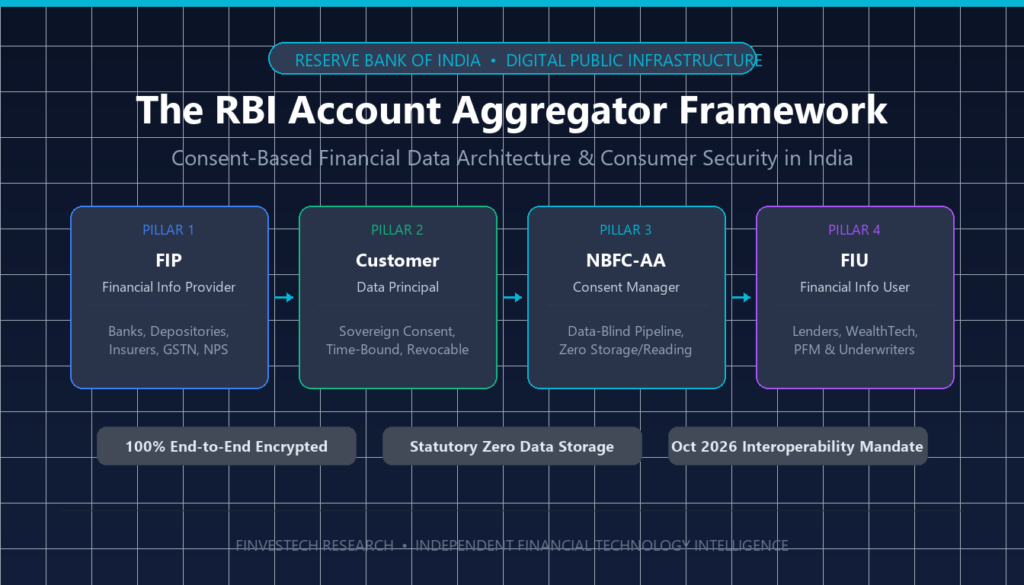
The Account Aggregator network operates through a structured four-pillar architecture where each participant has defined statutory boundaries:
[ Financial Information Provider (FIP) ]
   (e.g., State Bank of India, HDFC Bank, NSDL, LIC)
                 │
                 │  1. Data share requested
                 ▼
[ Customer / Data Principal ] ────► Approves Granular Consent
                 │
                 │  2. Tokenized consent artifact
                 ▼
[ NBFC - Account Aggregator (AA) ]  <─── DATA-BLIND PIPE
   (e.g., Finvu, OneMoney, Anumati, Setu)  (Encrypted Transit Only)
                 │
                 │  3. Delivers end-to-end encrypted packet
                 ▼
[ Financial Information User (FIU) ]
   (e.g., Digital Lenders, Wealthtechs, PFM Apps)
1. The Customer (Data Principal)
The customer is the sovereign owner of their financial data. Under Indian law and the Digital Personal Data Protection (DPDP) Act, financial records belong to the individual, not the bank holding them. The customer decides which accounts to link, who receives their data, what specific data fields are shared, how long access lasts, and whether consent is one-time or recurring.
2. Financial Information Provider (FIP)
An FIP is a regulated financial institution holding customer data. When an FIP receives an authenticated, cryptographically signed consent request via an Account Aggregator, it validates the token and transmits the specified data in an encrypted payload. FIP categories in India include:
- Banks & NBFCs (RBI): Scheduled commercial banks, small finance banks, payment banks, and lending NBFCs.
- Securities Entities (SEBI): Depositories (NSDL and CDSL), asset management companies (AMCs via RTAs like CAMS and KFintech), and stockbrokers.
- Insurance Companies (IRDAI): Life and general insurers holding policy values and coverage histories.
- Pension Funds (PFRDA): Central Recordkeeping Agencies (CRAs) managing National Pension System (NPS) accounts.
- Tax Authorities (GSTN): Goods and Services Tax Network, enabling MSMEs to share verified business turnover with commercial lenders.
3. Financial Information User (FIU)
An FIU is a regulated entity that consumes financial data to provide an authorized service. Common FIUs include digital lenders evaluating creditworthiness, wealthtech platforms aggregating net worth, and personal finance management (PFM) apps tracking budgets. To prevent unauthorized data access, an entity must be regulated by a financial regulator (RBI, SEBI, IRDAI, or PFRDA) to register as an FIU. Unregulated apps cannot join the network.
4. The NBFC-Account Aggregator (NBFC-AA)
The Account Aggregator is the intermediary pipe connecting FIPs and FIUs. It acts as an electronic consent broker. The AA translates customer approval into a machine-readable, tamper-proof electronic consent artifact. Crucially, the AA cannot see the contents of the financial data passing through its servers; its role is confined to authenticating the user, orchestrating the transfer, and maintaining an audit log.
Legacy Screen Scraping vs. RBI Account Aggregator: The Critical Difference
To appreciate the security leap the AA ecosystem represents, consider the direct architectural contrast between legacy data-gathering techniques and the RBI’s standardized model:
| Architectural Feature | Legacy Screen Scraping / PDF Uploads | RBI Account Aggregator Framework |
|---|---|---|
| Credential Sharing | Requires sharing NetBanking username and password with third-party software. | Zero credential sharing. Authentication occurs directly via mobile OTP or bank token. |
| Data Visibility by Intermediary | Third-party scrapers can view, parse, and log all account details and balances. | Data-blind. Aggregator carries encrypted payloads; it cannot decrypt or view data. |
| Data Storage by Intermediary | Statements and parsed financial records are frequently stored on fintech servers. | Zero storage. AAs are legally prohibited from caching, saving, or archiving customer data. |
| Encryption Standard | Inconsistent across platforms; plain text data often stored in intermediary databases. | End-to-end asymmetric encryption conforming to strict ReBIT technical standards. |
| Regulatory Oversight | Unregulated; operated outside statutory frameworks and violated bank terms of service. | Direct statutory regulation by the RBI under Master Directions 2016 and SRO Sahamati. |
| Granular Consent Control | All-or-nothing; scraping tools access everything visible inside the online banking portal. | Sovereign granularity. User selects specific accounts, data fields, date ranges, and expiry. |
| Consent Revocation | Difficult or impossible without changing bank passwords and terminating accounts. | Instant one-click revocation available at any time inside the customer’s AA dashboard. |
| Tamper Resistance | Low; PDF bank statements are easily manipulated using basic graphic editing tools. | Tamper-proof. Data is fetched directly from host institution APIs with digital signatures. |
Step-by-Step: How a Digital Consent Request Works in Real Life
For an everyday consumer, using an Account Aggregator takes less than two minutes:
Initiation: You apply for a financial service—such as a personal loan or digital credit line. Instead of asking for PDF statements, the app prompts you to share verified bank data via Account Aggregator.
Handle Identification: You enter your unique Account Aggregator handle (e.g., `yourname@finvu` or `yourname@onemoney`), or the platform detects your linked mobile number and suggests your registered AA provider.
Consent Presentation: You receive a push notification from your Account Aggregator app displaying a Consent Request Artifact outlining the requesting entity, the statutory purpose code, linked accounts, information scope, time horizon, and whether access is one-time or recurring.
Authentication: You review the terms and approve the request using a secure one-time password (OTP) sent to your registered mobile number by your bank and your AA.
Encrypted Execution: The AA passes the signed consent token to your bank (FIP). Your bank validates the signature, fetches the transaction records, encrypts the payload using the FIU’s public cryptographic key, and transmits it back through the AA pipe. The FIU decrypts the packet using its private key and processes your application immediately.
At no point in this sequence does the Account Aggregator see your transactions, nor does the lender obtain your login credentials.
Security, Privacy, and Data Governance: Is the AA Network Safe?
Given the rise in cyber fraud across the financial sector, skepticism regarding digital platforms is necessary. However, the RBI Account Aggregator framework was engineered with defense-in-depth principles:
1. Data Blindness by Design
The foundational technical principle of the AA ecosystem is data blindness. When an FIP transmits your financial records, the information is encrypted using the public key of the receiving FIU. The Account Aggregator acts like a postal courier carrying a locked steel safe: only the recipient holds the private key. The aggregator has zero technical capability to decrypt, parse, or read your statements.
2. Strict Prohibition on Data Storage
Under Section 5(2) of the RBI Master Directions, Account Aggregators are legally forbidden from storing or caching customer financial data on their servers. Once the encrypted data payload is delivered to the FIU, it is purged from the transit buffer. The only records an AA retains are non-financial operational audit logs—the timestamp of the consent, the identity of the FIP and FIU, and the transfer status—to fulfill regulatory compliance requirements.
3. Prohibition of Data Monetization
Unlike commercial web services that offer free tracking in exchange for selling transaction data to advertisers, NBFC-AAs are barred by statute from monetizing, aggregating, or reselling customer data. Their sole revenue model consists of transparent API transaction fees paid by the financial institutions requesting the data.
4. Alignment with the DPDP Act
The AA architecture represents the practical implementation of India’s Digital Personal Data Protection (DPDP) Act, 2023 (with administrative sub-rules undergoing phased notification). It enforces purpose limitation (data cannot be used for any unapproved purpose), storage limitation (data cannot be retained indefinitely), and complete consumer consent sovereignty.
Real-World Use Cases Transforming Indian Finance
The Account Aggregator framework is actively restructuring how retail consumers and small businesses interact with financial services in India.
A. Frictionless Credit Underwriting and Micro-Lending
Historically, individuals lacking formal salary slips struggled to access institutional credit. Lenders relied on rigid credit scoring models that often failed to capture real-time financial health. As explored in our analysis of retail banking credit scoring models, academic models frequently stumble in production environments because of dirty or delayed data. Through the AA framework, digital lenders evaluate verified, real-time cash flow with borrower consent, reducing approval times from days to minutes.
B. Automated Wealth Management and Net Worth Tracking
For retail investors managing portfolios spread across equity brokerages, mutual fund folios, provident funds, and bank accounts, manual consolidation has historically been a headache. By linking demat depositories (NSDL/CDSL) and RTAs (CAMS/KFintech) via AA, investors feed real-time, verified asset values into modern wealth platforms. Readers looking at how wealth management and wealthtech are evolving in 2026 can see firsthand how automated data consolidation is eliminating static spreadsheets.
Similarly, investors managing diversified holdings alongside high-yield banking instruments—such as those covered in our guide to high-yield fixed deposits in 2026—can effortlessly track accrued interest and maturity dates without manually requesting bank certificates.
C. Personal Finance and Budgeting Applications
Budgeting applications have historically suffered from high drop-off rates because manual expense logging is tedious, while SMS-scraping apps are prone to missing transactions and security restrictions on mobile operating systems. Account Aggregators allow trusted personal finance apps in India to obtain clean, categorized, read-only transaction feeds directly from banks, giving users an accurate, real-time picture of their spending habits without compromising banking security.
D. MSME Cash-Flow Lending via GST Integration
Small and medium businesses frequently face working capital shortages because traditional banks demand physical property as collateral. With the integration of the Goods and Services Tax Network (GSTN) into the AA ecosystem, small businesses can consent to share their verified GST return data (GSTR-1 and GSTR-3B) directly with commercial lenders. Banks can underwrite credit against verified business turnover and invoice flow rather than requiring land mortgages.
Verified Directory of RBI-Licensed Account Aggregators
To protect yourself from fraudulent applications, always verify that your Account Aggregator holds an active NBFC-AA Certificate of Registration (CoR) from the Reserve Bank of India. The following entities are operational and licensed to provide account aggregation services in India:
| Account Aggregator Brand | Operating Corporate Entity | Primary App / Handle Domain | Operational Status |
|---|---|---|---|
| Finvu | Cookiejar Technologies Private Limited | `@finvu` | Live / Fully Licensed |
| OneMoney | FinSec AA Solutions Private Limited | `@onemoney` | Live / Fully Licensed |
| CAMSFinServ | CAMS Financial Information Services | `@cams` | Live / Fully Licensed |
| Anumati | Protean Account Aggregator (Protean eGov) | `@anumati` | Live / Fully Licensed |
| Setu AA | Agya Technologies Private Limited | Embedded SDK / App | Live / Fully Licensed |
| Saafe | Dashboard Account Aggregation Services | `@saafe` | Live / Fully Licensed |
| NADL | NESL Asset Data Limited | `@nadl` | Live / Fully Licensed |
| CRIF Connect | CRIF Connect Private Limited | `@crif` | Live / Fully Licensed |
| Digio AA | Digio Internet Private Limited | Embedded SDK / App | Live / Fully Licensed |
| Cygnet AA | Cygnet Account Aggregator Private Limited | Business / Retail Portal | Live / Fully Licensed |
Note: Consumers do not necessarily need to download a standalone AA app. In many workflows, regulated lenders and fintech platforms embed an approved AA interface directly into their onboarding flow via secure, RBI-compliant software development kits (SDKs).
How to Track, Manage, and Revoke Your Consent
One of the most powerful features of the Account Aggregator framework is that consent is never permanent or irrevocable. You maintain sovereign authority over your financial data at all times.
If you have previously authorized an application to access your data—for instance, during a loan application or a wealth audit—you can review and revoke that permission whenever you wish:
Access Your AA Dashboard: Log into the Account Aggregator application you originally used (such as Finvu, OneMoney, or Anumati).
Review Active Consents: Navigate to the “Consents” or “Active Permissions” tab. You will see a complete, timestamped ledger of every institution that currently holds permission to fetch your financial records.
Examine Consent Details: Tap on any active record to inspect the exact parameters: the name of the FIU, the accounts linked, the data frequency (one-time vs. recurring), and the expiration date.
Execute Revocation: Tap “Revoke Consent”. You will be asked to confirm your choice.
Immediate Invalidation: The moment you confirm, the Account Aggregator invalidates the digital consent token across its network. The host bank (FIP) is automatically notified that the consent certificate has been terminated. If the FIU attempts to ping your bank for subsequent updates, the request will be rejected instantly by your bank’s API gateway. (Note: Revocation halts all prospective data pulls immediately; it does not retroactively erase historical transaction records that a regulated lender is legally required to archive under statutory loan compliance rules.)
The 2026 Milestone: RBI Interoperability and Consolidated Account Statements (CAS)
While the Account Aggregator ecosystem expanded rapidly between 2021 and 2025, reaching over 300 million linked accounts, it faced an operational bottleneck: ecosystem fragmentation.
Different banks and fintech platforms initially partnered with different individual Account Aggregators. A consumer who registered their primary account on Finvu might find that a new lender only supported OneMoney or Anumati, forcing the user to undergo redundant registrations and maintain multiple AA handles across different apps.
1. The October 2026 RBI Interoperability Directive
On October 7, 2026, in its landmark Statement on Developmental and Regulatory Policies, Reserve Bank of India Governor Sanjay Malhotra announced that the central bank would enforce full interoperability across all NBFC-Account Aggregators.
Under this regulatory directive:
- A consumer needs to onboard onto only one Account Aggregator of their choice.
- That single AA handle can seamlessly discover, link, and share financial information across any participating bank, depository, or insurer, regardless of which specific AA the receiving institution uses.
- On October 14, 2026, Reserve Bank Information Technology Private Limited (ReBIT) released the formal API Specifications for Interoperability, establishing standardized communication protocols across all AAs, FIPs, and FIUs. The central bank set a phased implementation deadline for ecosystem participants through December 31, 2026.
This development transforms the Account Aggregator network from a set of competing private pipelines into a unified digital public utility, mirroring the seamless interoperability that made UPI a global benchmark.
2. Integration of Bank Deposits into Depository CAS
In a parallel regulatory advancement announced alongside the interoperability mandate, the RBI collaborated with the Securities and Exchange Board of India (SEBI) to allow depositories (NSDL and CDSL) to incorporate bank deposit details directly into the Consolidated Account Statement (CAS) via NBFC-AAs.
Historically, the monthly CAS statement sent to Indian demat account holders only reflected mutual fund holdings, equities, and sovereign gold bonds. Retail investors were forced to check separate banking portals to assess their liquid cash and fixed deposits. Under the new framework, demat holders who provide consent through an Account Aggregator can receive a single, unified monthly statement capturing their complete liquid balance, fixed deposits, equities, mutual funds, and insurance portfolio in one verified document. This integration also significantly assists individuals and families in identifying dormant or forgotten bank accounts across multiple institutions.
Potential Risks, Practical Limitations, and Operational Hurdles
Despite the robust cryptographic architecture of the AA ecosystem, retail consumers should be aware of operational challenges and edge-case limitations:
- Bank API Latency and Downtime: While the AA protocol is real-time, its performance depends on the uptime of individual bank core banking systems (CBS). If a host bank’s API gateway experiences latency or server maintenance, the consent fetch can stall or time out, requiring the user to re-authenticate.
- Consent Fatigue: Because digital consent workflows are quick and frictionless, users may casually approve periodic, multi-year data sharing without carefully reading the expiry date or purpose parameters. Consumers must build the habit of auditing active consents every six months.
- Uneven Coverage in Small Institutions: While all major public and private sector banks (SBI, HDFC, ICICI, Axis, PNB) are live as FIPs, integration across smaller urban cooperative banks and regional rural banks remains in progress.
- Distinguishing Genuine AAs from Fraud Apps: Malicious lending apps frequently try to impersonate legitimate fintech tools. Consumers must verify that any app requesting financial data directs them to an RBI-licensed NBFC-AA handle rather than asking for raw NetBanking credentials or unauthorized SMS permissions.
Frequently Asked Questions (FAQs)
Can an Account Aggregator see my bank account balance or read my transactions?
No. Account Aggregators operate as strictly data-blind pipelines. All financial data transmitted across the network is encrypted using the public key of the receiving institution (FIU). The AA does not possess the cryptographic keys needed to decrypt the payload. By law, aggregators cannot see, parse, or store your transactions or balances.
Do I have to share my NetBanking password or ATM PIN with an Account Aggregator?
Never. You will never be asked for your NetBanking password, transaction password, or ATM PIN. Authentication occurs entirely through one-time passwords (OTPs) sent directly to your bank-registered mobile number. Any application asking for your NetBanking password is not using the legitimate RBI AA framework and should be avoided immediately.
What is the practical difference between an FIP and an FIU?
A Financial Information Provider (FIP) is an institution that holds your data (such as your bank, mutual fund house, depository, or insurance provider). A Financial Information User (FIU) is a regulated institution that requests your data to provide a service (such as a lender evaluating a loan application, a wealth manager analyzing your asset allocation, or a budgeting tool). Many institutions, such as large banks, act as both FIPs and FIUs in different contexts.
Can an Account Aggregator sell my financial information to credit bureaus or advertisers?
No. Under the RBI Master Directions 2016, NBFC-AAs are strictly prohibited from storing, sharing, or monetizing customer data. They cannot sell your financial information, use it to target advertisements, or transfer it to third parties without explicit, purpose-driven consent.
Is using an Account Aggregator mandatory for banking customers in India?
No. Participation in the Account Aggregator ecosystem is entirely voluntary. If you prefer not to use an AA, you retain the right to submit physical, paper-based bank statements or upload traditional documents. However, using the AA framework significantly reduces loan processing times, eliminates physical paperwork, and avoids the severe security risks associated with sharing unencrypted PDF statements.
How does the RBI’s October 2026 interoperability rule benefit me?
Prior to October 2026, consumers often had to register on multiple different AA platforms depending on which specific aggregator a bank or fintech supported. Under the RBI’s interoperability mandate, you only need to maintain one AA account. That single handle works universally across every participating bank, lender, and depository in India.
What should I do if an app requests continuous, indefinite access to my data?
You have the right to adjust the consent parameters before approving. If a lender or personal finance tool requests multi-year access when you only require a one-time service (such as a single loan approval), modify the duration to “One-Time” or set a short expiration date (e.g., 30 days) before confirming the OTP.
Editorial Conclusion & The Future of India’s Open Finance
The Reserve Bank of India’s Account Aggregator framework represents a decisive milestone in digital consumer empowerment. By stripping predatory third-party scrapers of their access to raw NetBanking passwords and returning data ownership to the individual citizen, India has engineered a secure, privacy-preserving open finance standard that is setting a global benchmark.
As interoperability reaches full deployment through the end of 2026 and depositories complete the integration of bank deposits into consolidated statements, the friction of personal financial management will continue to evaporate. For Indian consumers, the mandate is clear: embrace the security of consent-based data sharing, discard outdated methods of PDF statement sharing, and actively manage your digital consent permissions with the sovereignty that the law guarantees.
This guide was authored by The Chart Whisperer / Ashwin for Finvestech.in. Finvestech operates as an independent financial technology publication and maintains zero commercial affiliations, referral commissions, or sponsored agreements with any Account Aggregator, bank, or fintech platform mentioned in this article. Readers are encouraged to verify regulatory registries directly on the official portals of the Reserve Bank of India and Sahamati.